How Much Should You Charge for a Sponsored Post? Price It From Your Real Numbers
How Much Should You Charge for a Sponsored Post? Price It From Your Real Numbers
Every creator pricing guide gives you a table. Nano gets this, micro gets that. Then you send a quote, the brand asks how you arrived at it, and you have no answer beyond "that's the going rate".
That is how creators lose money. Not by asking too little, but by asking a number they cannot defend.
The tables are still useful. They tell you the range you are negotiating inside. But the number you send should come from your own reach, and you should be able to explain it in one sentence.
Every example below uses figures from a real channel, measured rather than estimated. They come from a ProveitGo kit, and they are deliberately small, because the method has to work for an account nobody has heard of or it is not a method.
What the 2026 benchmarks actually say
Start with the range. Hootsuite's influencer rate guide, updated 16 March 2026 by Colleen Christison, breaks it down by platform and tier:
| Tier | TikTok | YouTube | |
|---|---|---|---|
| Nano (1K-10K) | $20-$200 | $20-$500 | $100-$500 |
| Micro (10K-50K) | $200-$2,000 | $500-$2,000 | $500-$5,000 |
| Mid (50K-500K) | $2,000-$5,000 | $2,000-$5,000 | $5,000-$15,000 |
| Macro (500K-1M) | $5,000-$15,000 | $5,000-$20,000 | $15,000-$25,000 |
| Mega (1M+) | $15,000-$50,000+ | $20,000+ | $25,000+ |
Two things stand out.
YouTube pays more at every tier. A nano YouTuber starts where a nano Instagrammer tops out. Longer content, longer watch time, and a video that keeps being found through search rather than disappearing from a feed.
The ranges are enormous. Micro on Instagram runs from $200 to $2,000. A tenfold spread is not a pricing guide, it is a starting point. Where you land inside it is the actual question, and no table can answer it for you.
The Influencer Marketing Hub Benchmark Report 2026, published 4 May 2026 from over 600 respondents, adds the reality check: nano and micro creators cluster under $500 in most brand responses. The top of the published range is where a few creators land, not where most do.
Price from views, not followers
Here is the shift that changes the conversation.
Followers are what you have. Views are what the brand gets. Those are different numbers, and on some platforms they are wildly different.
A brand is buying attention. If you have 40,000 followers and your videos do 2,000 views, the brand is buying 2,000 views. If you have 3,000 followers and your videos do 30,000 views because the algorithm carries them, the brand is buying 30,000 views. The second creator should be paid more, and can prove why.
So price on a cost per thousand views, the same unit media buyers already use everywhere else.
Your rate = (median views ÷ 1,000) × your CPM
For creator content, a CPM between $20 and $50 is a workable starting band, above display advertising because the audience is engaged and the endorsement carries weight, below broadcast because reach is smaller. Where you sit inside that band depends on your niche and your engagement.
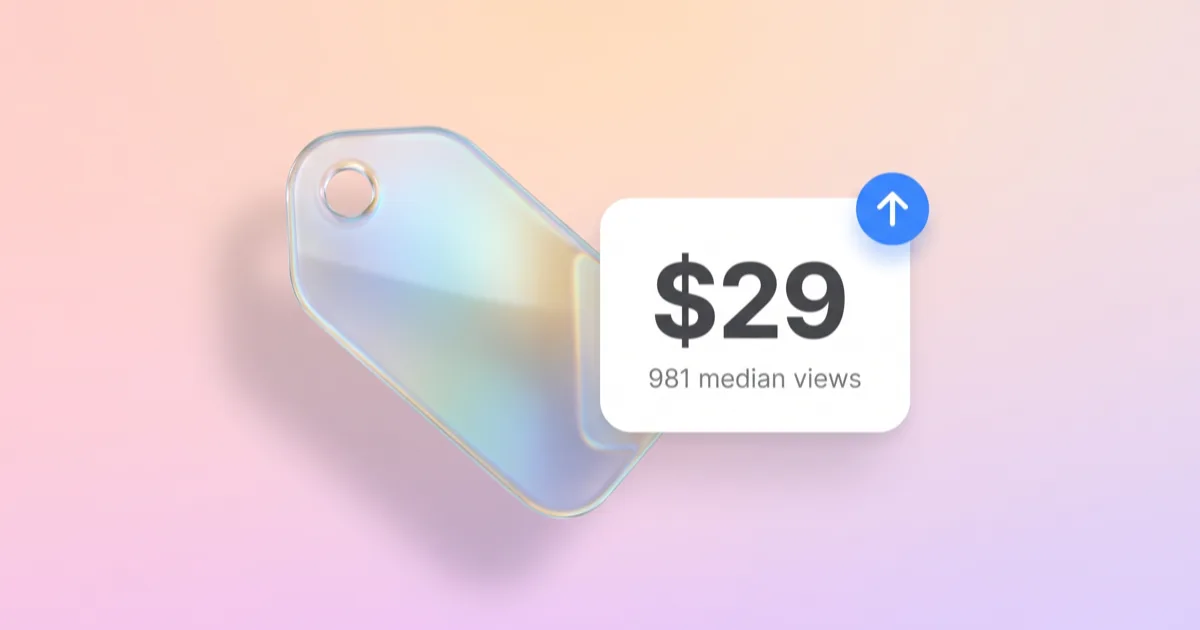
Worked example, on real numbers from a small account, the kind ProveitGo reads off a channel in about a minute:
| Value | |
|---|---|
| Median views per video | 981 |
| CPM | $30 |
| Base rate | $29 |
That looks tiny, and it is honest. A 281-subscriber channel is not a $500 partnership. But now look at the same creator's TikTok: 2,154 median views, which at the same CPM is $65. More than twice as much from the smaller follower count, because the views are what got sold.
Pricing on followers would have got that backwards.
Use the median, never the average
This detail moves your price more than any negotiating tactic.
If your last ten videos did 1,000 views except one that did 40,000, your average is 4,900. Your median is 1,000. Quote the average and you are pricing yourself on a lightning strike that will not repeat, and the brand will find out. Quote the median and you are pricing what actually happens.
The median is also what survives scrutiny. A brand that opens your channel sees a column of view counts. If your quote implies 5,000 views a video and the visible numbers say 1,000, the quote is dead and so is your credibility.
One caveat that matters for small or new accounts: a median from two or three videos is not a median, it is a coincidence. Use at least ten posts. If you do not have ten, say so, and expect the brand to price the uncertainty rather than pretend it away.
This is worth checking before you quote. Most free calculators do not tell you how many posts they read, and a rate built on three videos quotes like a rate built on twenty-five. ProveitGo works from the last 25 posts and prints that number next to the rate, which is the part a brand can argue with.
What raises your price
Base rate is the floor. Most of the money is in what you add on top, and the biggest mistake creators make is bundling these in for free.
Usage rights. If the brand wants to run your video as a paid ad, put it on their website, or use it beyond the original post, that is a separate product. Hootsuite's guide puts it plainly: "if you want to reuse the content in ads, on your website, or across additional platforms, expect to pay more." Price it as a percentage of the base rate, scaled by duration. Three months on their own channels is not the same as perpetual worldwide paid usage, and should not cost the same.
Exclusivity. An exclusivity clause means you cannot work with their competitors for a defined period. That has a direct cost to you: it is deals you cannot take. Hootsuite again: "Since this could cost the influencer prospective deals, it'll make the cost rise." Price it from what you would give up, and cap the duration and the category. "No competitors, ever, in all of beauty" is not a clause, it is an acquisition.
Volume and speed. More deliverables in one contract should get a discount, since your setup cost is spread. A rush turnaround should not.
Whitelisting. Running ads from your handle is worth more than running them from theirs, because it borrows your credibility. Price accordingly.
Quote each of these as its own line. A single lump sum invites the brand to negotiate the total. A breakdown makes them negotiate a specific item, which is a much better conversation for you, and it signals you have done this before.
What to do when they ask for a rate first
They will. Two workable answers.
Give a range with a condition. "Integrated video from $X, depending on usage rights and exclusivity." You anchor, and you flag the two variables that matter before they get assumed away.
Ask for the brief first. "Happy to quote once I know the deliverables, the usage and the timeline." Reasonable, professional, and it stops you quoting a post price for what turns out to be a three-month exclusive with paid amplification.
What does not work is naming a number with no basis. The moment you cannot explain it, the number becomes an opening bid, and every negotiation moves down from an opening bid.
Questions creators ask
Is a $30 CPM realistic for a small account? Yes, and small accounts often support more, because engagement per view is higher. The band matters less than being able to show the view count you multiplied.
Should I charge less because I have few followers? You should charge less because you deliver fewer views. That is the same sentence with a defensible reason attached, and it protects you when a large account with dead engagement undercuts you.
What if the brand offers product instead of money? Value the product at its retail price and compare with your rate. If a $60 item is offered for work you would price at $200, that is a $140 discount you are giving. Sometimes worth it early on. Just do the arithmetic first rather than after.
How do I raise my rates? When your median views rise. That is the whole answer, and it is why pricing on views rather than followers is worth the switch: it gives you a reason a brand can check, instead of an assertion.
Do I charge per platform or per campaign? Per deliverable, per platform. A YouTube integration and an Instagram Reel are different amounts of work reaching different numbers of people. Bundling them hides that and usually costs you.
Should my rate be public? A starting figure, yes, in your media kit. It filters out brands with no budget. Keep the full grid, with usage and exclusivity, for the actual conversation.
The short version
The published tables tell you the room you are negotiating in. They cannot tell you your price, because they do not know your views.
Take your median views, pick a CPM, multiply. That is your base. Then charge separately for usage rights and exclusivity, which is where the money actually is and where creators most often give it away.
The advantage of pricing this way is not that the number comes out higher, though it often does. It is that when the brand asks how you got there, you have an answer, and they can check it.
Your median views, measured rather than estimated: ProveitGo builds a free media kit from your channels, so the number you quote is one a brand can verify.
Verify before you pay. Prove after you launch.
ProveitGo detects fake followers, bot engagement and fraud, then tracks real conversions. One dashboard, 60 seconds.
Run an Influencer Audit →